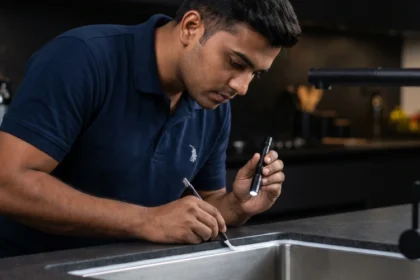




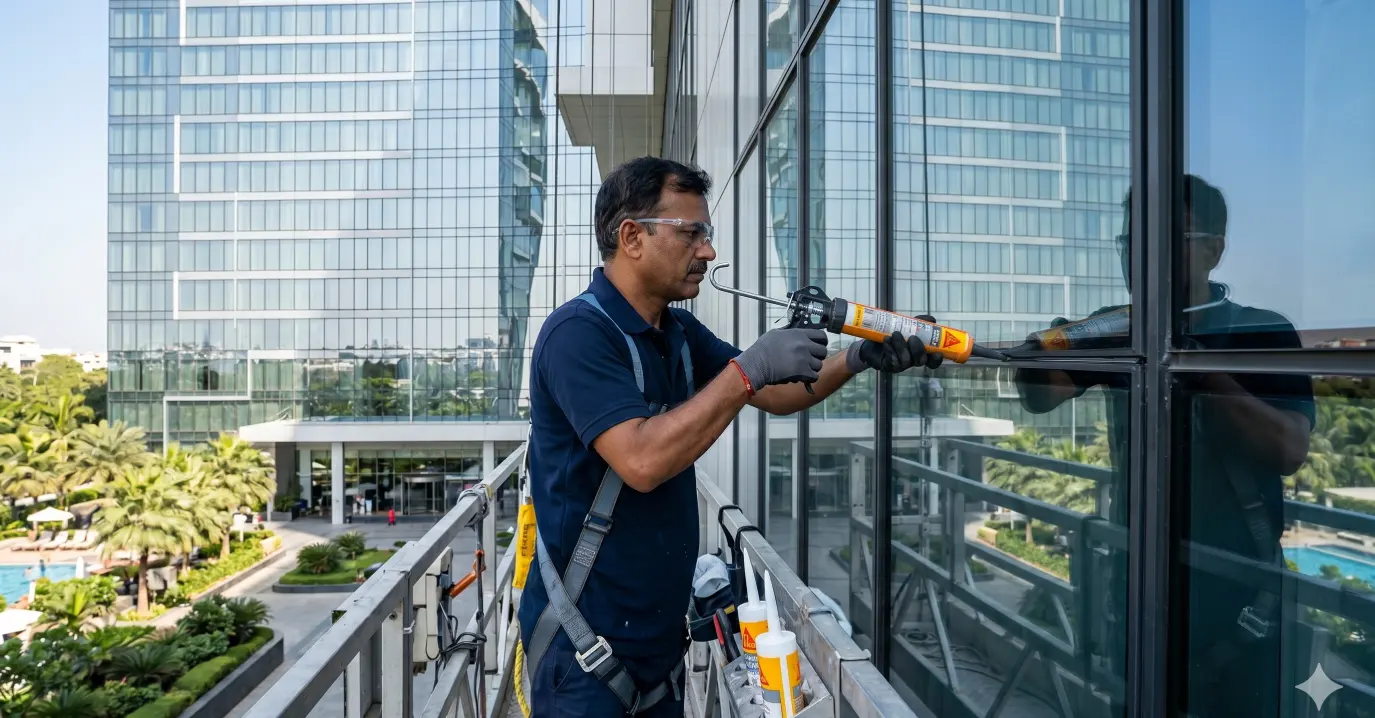
It was a Tuesday morning in Gurugram. A facility manager — let’s call him Mr. Sharma — was doing his usual walkthrough of a twelve-storey commercial tower his company had occupied for nine years.
He’d walked past the curtain wall a thousand times. Spotless glass. Polished aluminium frames. The building looked brand new from the street.
Then the monsoon arrived.
Within four days of the first heavy rain, water had seeped behind three glass panels on the seventh floor.
The ceiling tiles of the boardroom were stained. Two server racks were moved under emergency protocol.
The investigation found something that had been quietly happening for two years: the structural silicone glazing at the panel joints had oxidised, cracked along the bond line, and lost adhesion — entirely invisibly from the outside.
The repair bill?
Over ₹18 lakh, once you added water damage, panel removal, structural inspection, and replacement sealing. The cost of a timely re-seal three years earlier would have been a fraction of that.
Mr. Sharma’s story is not unusual.
It plays out in office towers, hospitals, airports, and premium residential complexes across India every monsoon season.
And it raises a question that every property owner, RWA secretary, and facility manager must confront honestly:
?
When did you last inspect your structural silicone glazing? Not visually from the ground — actually inspect it?
What Is Structural Silicone Glazing — And Why Is It Load-Bearing?
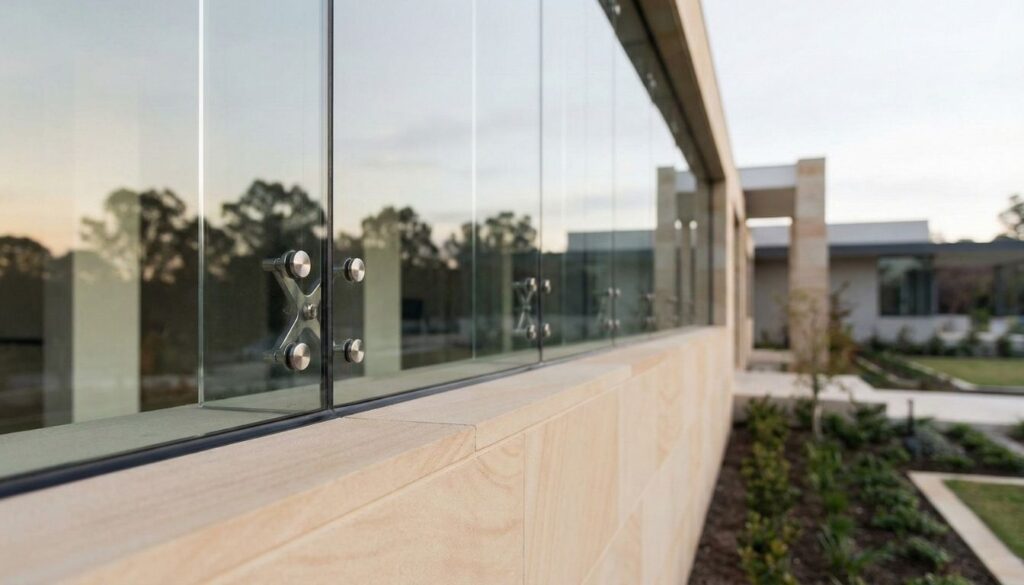
Structural silicone glazing (SSG) is a modern method that bonds glass directly to a building’s metal frame using a high-strength silicone sealant—no screws, bolts, or metal retainers needed.
The silicone does two jobs at once: it holds the glass in place (structural support) and seals out water and air (weatherproofing).
Think of it this way: in a conventional glazing system, metal caps and pressure plates hold the glass in place and remain visible from the outside.
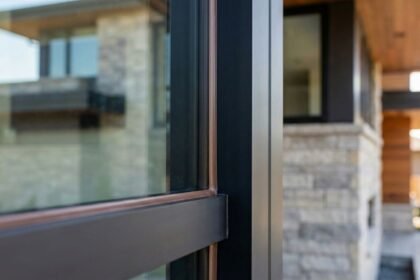
In a structural silicone glazing system, specially engineered silicone performs the structural connection between the glass and the frame, allowing the exterior surface to appear almost entirely glass.
SSG is like taking a frameless mirror and gluing it directly to your wall.
In a standard SSG glazing configuration, the silicone is the only thing preventing the glass from detaching from the building envelope. It resists wind loads, thermal movement, seismic micro-vibrations, and gravity. The technical term is dead-load and live-load transfer — and the silicone manages both.
This is what makes it categorically different from ordinary glazing windows with caulk.
Caulk is a cosmetic and weatherproofing material. Structural silicone for glass is an engineered adhesive with defined tensile and shear strength specifications, typically tested to ASTM C1184 or equivalent international standards.
When that bond degrades — and all silicone eventually degrades — the consequences are not a dripping window. They are a detaching panel.
15–25
Years of typical lifespan of structural silicone glazing
40°C+
Thermal cycling stress in Indian climate zones
3x
Cost multiplier: reactive repair vs. planned re-sealing
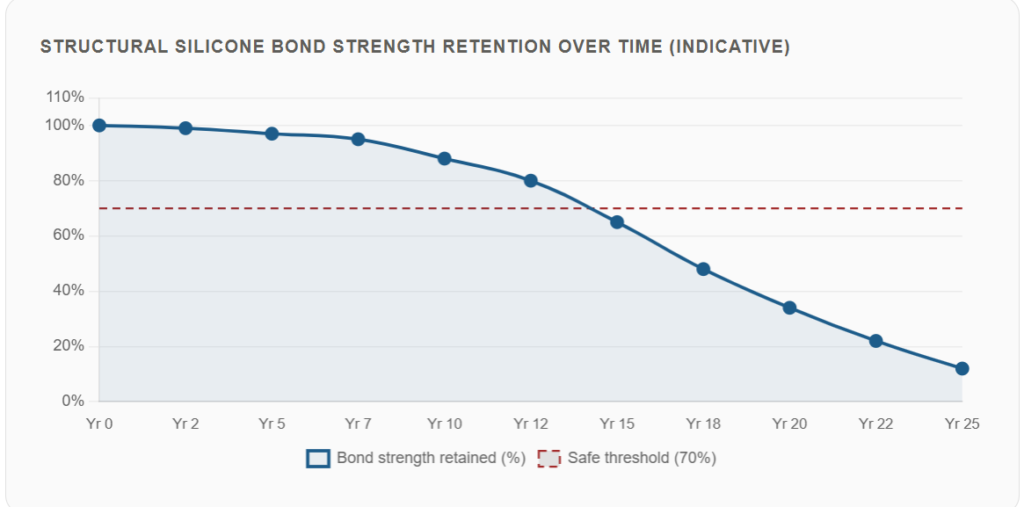
The Degradation Timeline No One Shows You
The failure of structural silicone glazing is not sudden.
It is a slow, cumulative process — and the most dangerous phase is the one where the building still looks perfectly fine from the outside.
Years 1 – 3: Peak performance
Full bond strength. Silicone remains flexible, UV-stable, and watertight. No action required beyond annual visual check.
Years 3 – 8: Early degradation
UV oxidation begins on the sealant surface. Slight surface cracking may appear. Bond strength still adequate but reducing. Professional inspection recommended every 2 years.
Years 8 – 15: Critical window
Cohesive and adhesive failure accelerating. Silicone may appear intact visually but has lost 40–60% of original bond strength. Water infiltration begins. This is the ideal window for re-sealing.
Years 15 – 25+: Failure zone
Active delamination. Risk of glass panel detachment during high wind events, monsoon loading, or seismic activity. Immediate structural inspection and full re-sealing mandatory.
Is Your Façade Already Giving You Warning Signs?
Most façade failures announce themselves — but only to those who know what to look for. Run through this quick inspection checklist for your property. Check every sign you’ve observed:
Façade Condition Self-Assessment
If you checked three or more items above, your building is overdue for a professional structural silicone glazing inspection. If you checked five or more, treat this as urgent.
Why Indian Climate Conditions Accelerate Failure
Silicone sealants are rated for global climates — but India’s specific environmental profile creates a uniquely aggressive degradation environment for silicone structural glazing systems:
UV radiation intensity:
India receives some of the highest UV indices in the world. Sustained UV exposure is the primary driver of silicone oxidation and surface embrittlement, directly compromising the bond to glass and aluminium substrates.
Thermal cycling extremes:
Delhi NCR routinely sees 45°C summers and near-freezing winter nights. This ±40°C daily and seasonal swing creates relentless mechanical stress on silicone joints — the glass expands and contracts at a different rate than the aluminium frame, and the silicone must accommodate both.
Monsoon hydrostatic pressure:
Heavy monsoon rain creates wind-driven water at pressures that probe every micro-crack in degraded silicone. Many buildings pass visual inspection in April but show active water ingress by July — that’s the monsoon revealing what degraded SSG glazing had already allowed.
Pollution and particulate deposition:
In high-AQI environments like Delhi, particulate matter embeds into sealant surfaces and chemically accelerates UV degradation, shortening the effective service life by two to five years versus cleaner environments.
Structural Silicone vs. Standard Caulk: Understanding the Difference
A dangerous misconception in the Indian construction and maintenance market is that glazing windows with silicone and glazing windows with caulk are interchangeable — that one brand of white sealant is as good as another for a glass façade. It is not.
| Property | Structural Silicone (SSG-grade) | Standard Caulk / General Sealant |
|---|---|---|
| Load-bearing capacity | ✔ Engineered load transfer | ✘ None — cosmetic only |
| UV resistance | 20+ years (high-spec formulations) | 3–7 years before degradation |
| Movement accommodation | ±25% joint movement capability | ±5–10% — cracks under thermal cycling |
| Bond to glass | Permanent adhesive bond | Surface adhesion only |
| Suitable for façade glazing | Yes — purpose-designed | No — code non-compliant for SSG |
| Used for reseal double glazing / double pane windows | With appropriate primer — yes | For perimeter sealing only — never structural |
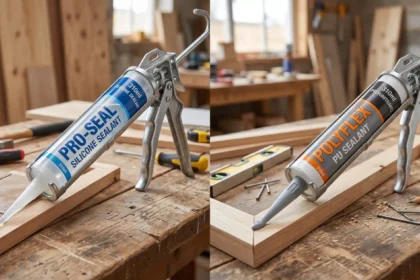
The right material for a structural silicone glazing curtain wall re-sealing project is always an ASTM C1184 or C920-compliant structural silicone — formulations like DOWSIL 795, Sika SG-20, or equivalent.
Using a lesser sealant is not a cost saving. It is a liability.
A Special Note on Double Glazed Units
If your building uses silicone for double glazed units — also called IGUs (insulated glass units) — re-sealing carries an additional dimension beyond structural integrity: thermal performance and fog prevention.
When the edge seal of a double glazed window fails, the desiccant inside the spacer bar becomes saturated, and the internal argon or air gap allows condensation.
The telltale sign is permanent fogging between panes that cannot be cleaned from either surface.
Once this happens, resealing double glazing from the outside perimeter alone will not restore clarity — the IGU itself must be replaced.
However, early intervention — resealing double pane windows at the perimeter before the internal seal fails — can significantly extend the functional life of an IGU and prevent the far costlier unit replacement.
Silicone for double glazed windows used at this perimeter joint must be a neutral-cure formulation compatible with the IGU’s edge sealant to avoid chemical attack and accelerated failure.
What Proper Structural Silicone Glazing Re-Sealing Looks Like
Understanding what a professional re-sealing engagement should involve helps property owners ask the right questions — and avoid the very common trap of hiring the lowest bidder who applies new silicone over old, degraded material. That is not re-sealing. That is aesthetics over an active structural hazard.
A compliant structural silicone glazing re-sealing process covers:
The Legal Reality: Safety Obligation, Not Optional Maintenance
In India, the National Building Code (NBC) and local municipal regulations increasingly place explicit maintenance obligations on building owners for façade systems.
A detached glass panel is not treated as an accident — it is treated as negligence. Liability for bodily injury, property damage, or death resulting from façade failure falls on the building owner and the registered facility management agency.
Are you prepared to carry the legal and moral weight
The question is not whether re-sealing your structural silicone glazing is worth the cost. The question is whether you are prepared to carry the legal and moral weight of not doing it.
Beyond legal liability, consider what SSG failure actually means in a building context: a glass panel weighing 80–200 kg detaching at height.
The force of impact at ground level can be lethal.
In high-pedestrian environments — commercial lobbies, hospital entrances, school façades, transit hubs — this is not a remote risk to be managed probabilistically. It is a foreseeable hazard that building owners have a duty to prevent.
The Right Time to Act Is Before You Have to
Mr. Sharma from the opening of this article eventually got his re-sealing done — along with a very expensive lesson in what deferred maintenance costs in the real world. His building now has a documented inspection schedule, a verified sealant specification on file, and peace of mind through every monsoon season.
That kind of confidence doesn’t come from hoping the façade holds. It comes from knowing it will — because you’ve made it your responsibility to ensure it does.
Structural silicone glazing is the only barrier between your glass panels and the forces that want to bring them down. It is not optional maintenance. It is a structural safety obligation — and treating it as anything less is a risk no building owner, facility manager, or RWA secretary should be willing to carry.
Book a Professional Façade Inspection
Silicone Crew operates across Delhi NCR, Mumbai, Bengaluru, Hyderabad, Pune, Ahmedabad, Noida, Gurugram, and Faridabad. Our structural silicone specialists provide documented inspection reports, adhesion testing, and full re-sealing services for residential towers, commercial complexes, and industrial façades.
Request a Free Site Assessment