



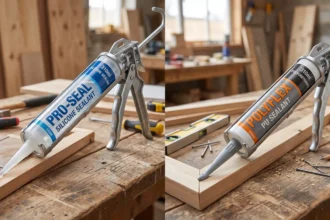

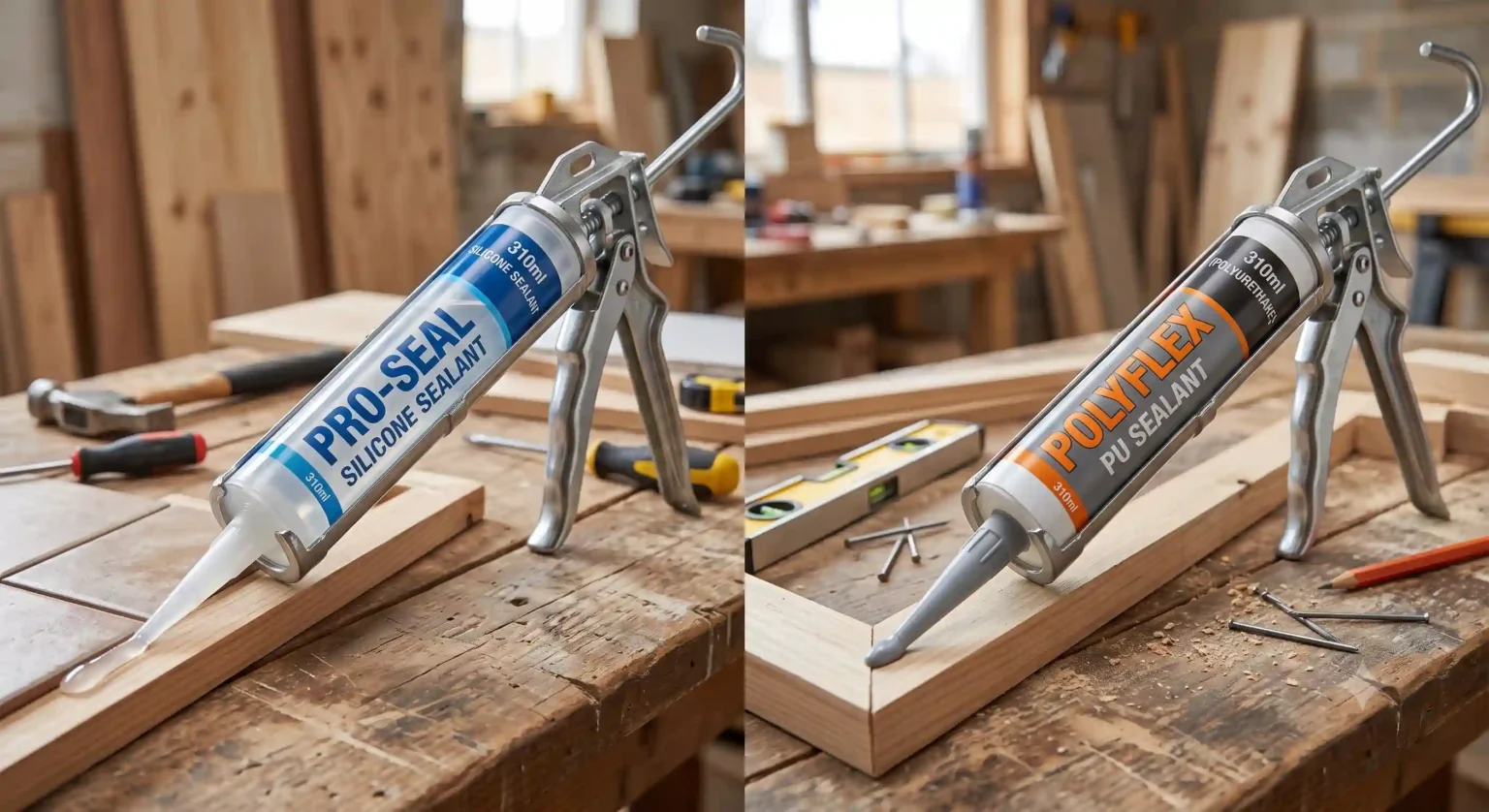
Imagine I hand you two identical white cartridges.
I remove the labels.
I place them on a table and ask you a simple question:
Which one would you trust to protect a ₹50 crore glass façade for the next twenty years?
You can’t answer it.
Not because you aren’t experienced. Not because you don’t understand construction. Simply because, from the outside, the two products look almost identical.
Yet one cartridge may be engineered to survive relentless UV exposure, heavy monsoon rain, façade movement, and years of thermal expansion. The other may excel in completely different conditions but fail much sooner if used in the wrong application.
This is where countless construction decisions quietly go wrong.
Contractors compare prices. Procurement teams compare brands. Homeowners compare cartridge sizes. Almost nobody compares the chemistry.
And chemistry is exactly what determines whether a joint performs flawlessly for decades—or quietly begins failing long before the building reaches its first major maintenance cycle.
Silicone and polyurethane (PU) sealants are often treated as alternatives. In reality, they solve different engineering problems. Knowing which one belongs where isn’t product knowledge—it’s risk management.
“The cost of the sealant is almost nothing compared to the cost of the façade it protects. The only expensive decision is the wrong one.”
First — what are these two products, actually?
Before we get into which one goes where, it helps to understand what you’re actually working with. Not the chemistry degree version — just enough to make the right call on site or when briefing a contractor.
Silicone sealant
Silicone is an inorganic material — meaning it’s built on a silicon-oxygen backbone rather than carbon. That one fact explains almost everything about how it behaves.
Because it’s inorganic, it doesn’t break down the way organic materials do.
UV radiation, ozone, extreme heat, prolonged moisture exposure — none of these significantly affect silicone’s structure. It stays flexible, stays bonded, and stays put for up to 20 years in the right application.
The trade-off: silicone is generally not paintable, doesn’t bond well to wood or concrete without a primer, and can be slippery to tool. Once cured, it’s also quite difficult to remove completely.
Polyurethane (PU) sealant
PU is an organic compound — formed from a chemical reaction between polyols and isocyanates.
It cures through moisture absorption, creating a rubber-like, flexible seal with excellent adhesion to a very wide range of porous surfaces: concrete, wood, masonry, brick.
It can be painted. It sands well. It tends to have higher abrasion and tear resistance than silicone.
The trade-off: PU is organic, which means it can degrade under prolonged UV exposure — it yellows, becomes brittle, and loses flexibility over time unless specially formulated with UV stabilisers.
It also has lower movement capability than silicone (typically ±25–35% versus silicone’s ±50%), and in high-humidity environments, some PU formulations develop pinholes during curing — small bubbles trapped in the sealant body that compromise the seal.
Silicone vs PU Sealant: Why Do So Many People Think They’re the Same?
Walk into any silicone sealant dealer shop, and you’ll probably find both silicone sealants and polyurethane (PU) sealants sitting side by side.
They often come in similar cartridges, are applied using the same caulking gun, and both claim to seal gaps, stop water leaks, and create flexible joints.
At first glance, it’s easy to assume they’re simply different brands of the same product.
In fact, this is one of the most common misconceptions among homeowners, contractors, architects, and even some construction professionals. It’s not unusual to hear questions like:
Can I use PU instead of silicone?
Aren’t they both waterproof sealants?
If they both seal joints, why does it matter which one I buy?
Is polyurethane just a stronger version of silicone?
These are valid questions because silicone and PU sealants do share several important characteristics:
What Silicone and PU Sealants Have in Common
At first glance, silicone sealants and polyurethane (PU) sealants appear remarkably similar.
| Similarity | Silicone Sealant | Polyurethane Sealant (PU) |
|---|---|---|
| Packaging | Cartridges or sausages | Cartridges or sausages |
| Application Tool | Caulking gun | Caulking gun |
| Flexible after curing | Yes | Yes |
| Air Sealing | Water, Air and Dust Infiltration | Water, Air and Dust Infiltration |
| Dust Sealing | Yes | Yes |
| Exterior applications | Yes | Yes |
| Interior applications | Yes | Yes |
| Used in commercial buildings | Yes | Yes |
| Used in residential construction | Yes | Yes |
| Used around windows | Yes | Yes |
If your only comparison is based on appearance or the general purpose written on the packaging, they can seem almost identical.
However, this surface-level similarity is exactly where many costly mistakes begin.
The reality is that while silicone and PU sealants may perform the same job, they don’t perform it in the same way. Their chemical composition, long-term durability, flexibility, UV resistance, adhesion properties, paintability, maintenance requirements, and ideal applications are fundamentally different.
If They Have So Much in Common, Why Are They Treated So Differently?
By now, it’s easy to see why silicone and PU sealants are so often confused. They share many of the same goals: sealing joints, blocking water, remaining flexible, and protecting buildings from the elements.
In everyday conversation, they can even seem interchangeable because they solve similar problems.
But this is where many people make a costly assumption.
However, beneath these similarities lie significant differences in chemistry, performance, durability, and intended applications. Choosing one based solely on appearance or price can lead to premature joint failure, water leakage, difficult maintenance, and unnecessary repair costs.
What’s the difference between silicone and PU sealant?
| Property | Silicone Sealant | PU (Polyurethane) Sealant | Which Performs Better? |
|---|---|---|---|
| Base Chemistry | Polysiloxane | Polyurethane polymer | Different applications |
| Primary Purpose | Long-term weather sealing | Bonding, sealing | Depends on application |
| Typical Service Life | (10–25)+ years | 5–15 years | Silicone |
| UV Resistance | Excellent | Moderate to good | Silicone |
| Weather Resistance | Outstanding in rain and sun | less durable | Silicone |
| Temperature Resistance | -50°C to +150°C | -40°C to +90°C | Silicone |
| Flexibility After Years | Retains flexibility for decades | Becomes harder with age | Silicone |
| Waterproof Performance | Excellent | Excellent | Tie |
| Adhesion Strength | Excellent | Superior than silicone | PU |
| Paintability | Cannot be painted | Easily paintable after curing | PU |
| Abrasion Resistance | Moderate | Excellent | PU |
| Application on Concrete | Good with suitable grade | Excellent | PU |
| Application on Wood | Fair to good | Excellent | PU |
| App. on Metal Fabrication | Good | Excellent | PU |
| Façade Glazing | Industry standard | Rarely used | Silicone |
| Structural Glazing | Structural grades available | Not suitable | Silicone |
| Floor Joints | Less common | Widely preferred | PU |
| Industrial Floors | Less common | Preferred | PU |
| Exterior Window Perimeters | Best choice | Acceptable | Silicone |
| Bathroom & Kitchen Joints | Excellent | Less common | Silicone |
| Resistance to Fungal Growth | Sanitary grades available | Limited | Silicone |
| Maintenance Frequency | Lower | Higher | Silicone |
The fact that two sealants can perform the same function does not mean they deliver the same performance. Their underlying chemistry influences how they react to sunlight, moisture, temperature changes, movement, chemicals, and aging over time. Those differences determine where each sealant excels—and where it can fail.
The bathroom — why silicone wins, every time
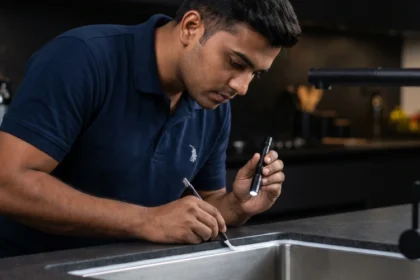
Let’s start with the application most homeowners care about, because this is where the wrong product gets used most frequently.
Walk into any hardware store in Delhi or Pune and ask for “bathroom sealant.” There’s a reasonable chance the person behind the counter will hand you either a standard silicone cartridge or a PU-based product without asking a single question about your specific application. Both are white. Both come in 300ml cartridges. Both say “waterproof” on the label.
Here’s why only one of them belongs in your bathroom.
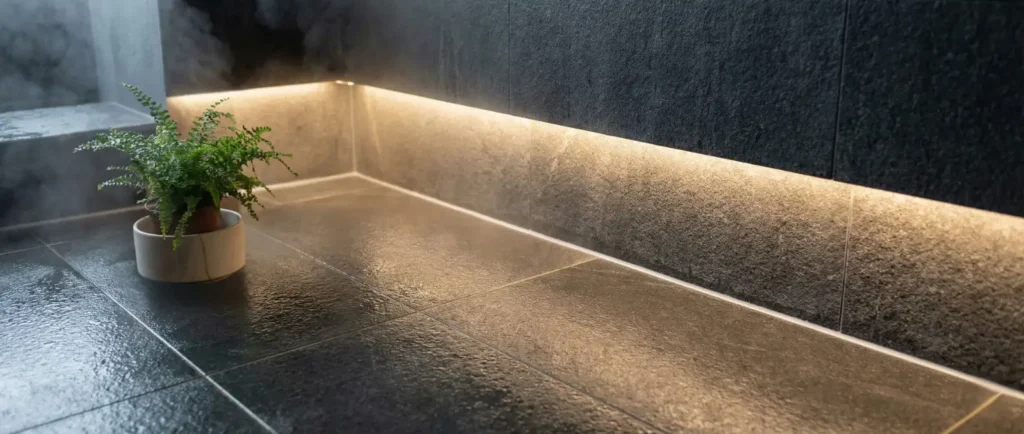
A bathroom is a permanently wet zone. Steam, standing water, direct water contact from showers — all of it, every day. PU sealant, despite being marketed as waterproof, is an organic compound.
In a continuously wet environment, especially one with fluctuating temperatures and poor ventilation, PU degrades. It absorbs moisture over time, swells, loses elasticity, and eventually fails its bond to the tile or tray surface.
Most PU sealants in wet zones show visible deterioration within 18 months to 3 years.
Silicone, being inorganic, is genuinely hydrophobic — it repels water at a molecular level, not just at the surface. It doesn’t swell, doesn’t absorb moisture, and doesn’t lose flexibility in a humid environment. High-quality sanitary-grade silicone in a correctly applied bathroom joint will last 5–10 years in Indian conditions.
Critical distinction
Not all silicone is sanitary grade. A structural or general-purpose silicone applied in a bathroom provides waterproofing but no fungicide. In India’s monsoon humidity, mould will colonise the surface within months. The correct specification for any bathroom wet zone — shower, bathtub, shower tray, basin — is always sanitary-grade anti-fungal silicone, neutral-cure formulation.X
Where PU does have a limited bathroom role
There is one specific bathroom application where PU sealant is appropriate: filling larger structural cracks in concrete walls or floors before waterproofing — not as the finished seal in a wet zone, but as a filler or backing material for cracks wider than 10mm where flexibility and adhesion to concrete is required. After the PU fill has cured, the joint is then finished with silicone for the permanent wet-zone seal. This is complementary use, not substitution.
The façade — where both products have a legitimate role
This is where the specification conversation gets more interesting, and where the most expensive mistakes happen in commercial construction in India.
A modern building façade has multiple joint types — and they don’t all need the same sealant. The error most contractors and project managers make is specifying one product across the entire façade because it’s simpler. It isn’t simpler. It’s just cheaper upfront and significantly more expensive over five years.
Weather sealing joints on glass and ACP façades: silicone
The joints between ACP (Aluminium Composite Panel) cladding panels, between glass units, and between glass and aluminium framing are exposed to direct UV radiation, thermal expansion and contraction, wind pressure, and rain — every day, year-round.
The sealant in these joints must accommodate significant movement (ACP panels can expand and contract by 3–5mm over a day’s temperature swing in Indian summer conditions) and must resist UV degradation for the life of the building.
This is silicone’s territory, definitively. A neutral-cure silicone — medium modulus for most façade applications — maintains its elasticity and UV resistance for 15–20 years. The same joint sealed with standard PU will begin yellowing within 2–3 years and become brittle and crack-prone within 5.
On a commercial building, that means remedial re-sealing of the entire façade — a cost that dwarfs the saving made by specifying cheaper PU in the first place.
Expansion joints in concrete and masonry: PU often wins here
Expansion joints in concrete structures — floor slabs, parapet walls, precast elements — are a different matter. Here, the substrate is porous concrete or masonry, the joint movement is lower-amplitude and more predictable, and paintability may be required (PU can be painted; silicone cannot).
PU sealant bonds to concrete without primer in most cases, making application faster and more reliable on rough, porous surfaces.
A high-quality one-component PU sealant from brands like Sikaflex, DOWSIL, or Asian Paints SmartCare Hybrid PU is a legitimate, professional-grade specification for concrete expansion joints, window-to-masonry perimeter joints, and precast element sealing — where the surface is porous, the movement is moderate, and UV exposure is not the primary stress factor.
Use Silicone Sealant
Glass-to-aluminium joints
High UV exposure, continuous movement. Silicone’s ±50% movement capability and UV stability make it the only correct choice.
ACP cladding panel joints
Thermal expansion in Indian climate is severe. Only neutral-cure silicone provides the movement capacity and UV resistance required.
Curtain wall weathersealing
Wind loads, pressure differentials, and thermal cycling demand silicone’s combination of elasticity, UV resistance, and long-term durability.
Stone & Granite Cladding
Special neutral-cure silicone is used around natural stone to avoid staining while providing weatherproof and flexible joints.
Use Polyurethane (PU) Sealant
Concrete expansion joints
PU bonds to porous concrete without primer and handles moderate movement well. Paintability often required.
Precast concrete joints
Dense, porous substrate with lower movement amplitude. PU’s abrasion resistance and strong adhesion to concrete are decisive advantages here.
Window-to-masonry perimeter
Where the substrate is brick or plaster and the joint will be painted over, PU’s superior adhesion to masonry is an advantage.
Brick expansion joints
Ideal for movement joints in brick façades because it bonds well to masonry and can be painted to blend with surrounding walls.
Structural glazing — silicone only, no exceptions
If you take one thing away from this entire article, make it this: polyurethane sealant is never a specification for structural glazing applications. Ever. Under any circumstances.
Structural glazing is the system where glass panels are bonded directly to an aluminium frame using silicone adhesive — there are no mechanical fixings at the glass edges.
The silicone is the only thing holding the glass to the building. Wind loads, impact loads, and dead weight all transfer through the sealant bond.
This is life-safety engineering. The Indian glass façade market saw significant scrutiny after several high-profile panel failures in commercial buildings — and in nearly every forensic analysis, the root causes included wrong sealant specification, incorrect joint dimensions, or inadequate substrate preparation.
Structural silicone — specifically two-component, high-modulus structural glazing silicones from brands like DOWSIL (795, 993, 983), Sikasil SG-500, or Wacker SilFlex — is the only category of sealant engineered, tested, and certified for this application.
These products meet ASTM C1184, ETAG 002, and ISO standards for structural sealant glazing. They are tested for tensile strength, elongation, tear resistance, and long-term durability under cyclic loading.
The honest comparison — head to head
Not sure which one you need? Use this
Answer three quick questions about your application and get an instant recommendation.
The honest answer to “which one should I use?”
Silicone and PU are both legitimate, professional-grade sealants.
Neither is universally better than the other. The right answer is entirely determined by the application — and in India’s climate specifically, where heat, humidity, and monsoon rainfall create some of the most demanding conditions for any sealant in the world, getting that answer right matters more than almost anywhere else.
The simple version:
- Any wet zone, any bathroom, any permanent water contact: sanitary-grade anti-fungal silicone.
- Any glass façade, ACP joint, curtain wall, or high-UV exterior joint: neutral-cure silicone, medium or high modulus.
- Any structural glazing application: engineered, rated, two-component structural silicone — no exceptions.
- Concrete expansion joints, masonry cracks, brick perimeter joints, painted surfaces: high-quality one-component PU sealant.
- Window frame to plaster or brick wall (to be painted): PU sealant or hybrid MS polymer.
If you are a homeowner, the answer is almost always sanitary-grade silicone for inside the home and neutral-cure silicone for windows and exterior joints.
If you are a contractor or facility manager specifying sealants for a commercial project, the application-by-application breakdown above is your guide — and when in doubt, a professional sealant survey is significantly cheaper than remedial façade work.
Estimated reading time: 16 minutes